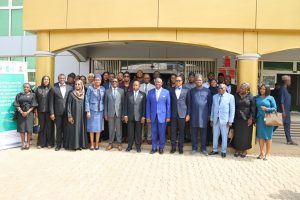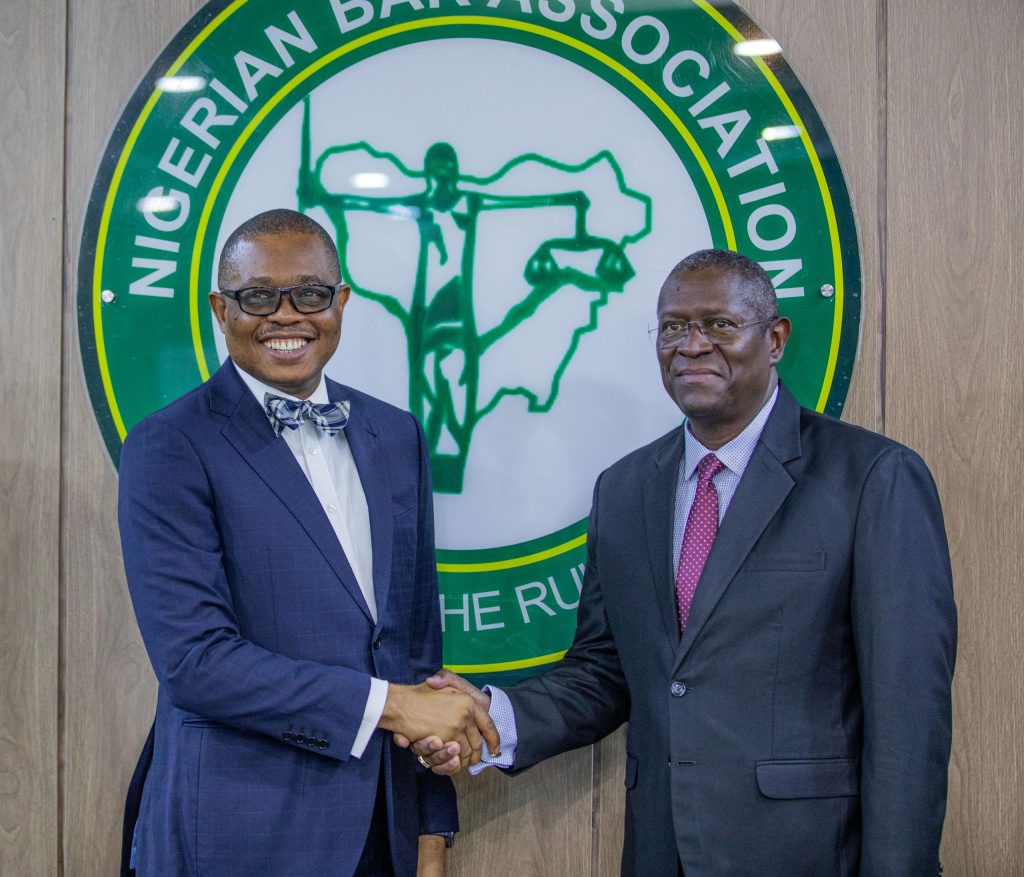
The President of the Nigerian Bar Association (NBA), Mazi Afam Osigwe, SAN, yesterday February 16th, 2026, received in audience the President of the ECOWAS Court of Justice, Honourable Justice Ricardo Cláudio Monteiro Gonçalves, alongside other Judges of the Court and senior members of its Registry and staff, at the NBA National Secretariat.
Welcoming the distinguished delegation, the NBA President noted that the NBA is the umbrella body of all legal practitioners in Nigeria and a steadfast advocate for the rule of law, constitutional governance, and access to justice within Nigeria and across the West African sub-region.
He described the visit as both timely and strategic, as it centres on a matter fundamental to the survival and credibility of judicial institutions: the enforcement of judgments. According to him, judicial authority is not sustained merely by the pronouncement of decisions, but by the certainty that those decisions will be obeyed. Where court judgments are routinely disobeyed or ignored, the very foundation of justice is weakened.
The NBA President emphasized that for a supranational court such as the ECOWAS Court to retain legitimacy and command the confidence of citizens and Member States alike, its decisions must be treated as binding obligations rather than advisory declarations. He noted that enforcement is the lifeblood of adjudication and that without compliance, even the most well-reasoned judgments risk becoming symbolic. He therefore assured the Court of the NBA’s readiness to collaborate in advancing practical and sustainable mechanisms that will strengthen compliance and deepen respect for the Court’s authority across the region.
In his remarks, Honourable Justice Ricardo Cláudio Monteiro Gonçalves expressed appreciation for the warm reception and the opportunity to engage directly with the leadership of Nigeria’s foremost professional legal body. He noted that the Court’s ongoing engagements across Member States are aimed principally at addressing the persistent challenges surrounding the enforcement of its judgments.
The President of the Court underscored that among the Judges, enforcement remains a pressing institutional concern with far-reaching implications for the Court’s credibility, authority, and long-term relevance. He observed that the effectiveness of regional human rights protection and treaty enforcement depends significantly on the willingness of Member States to comply with and give domestic effect to the Court’s decisions. Without effective enforcement frameworks, public confidence in regional justice mechanisms may gradually erode.
He stressed that collaboration among the judiciary, the Bar, the executive arm of government, and civil society is indispensable to resolving these challenges. Strengthening dialogue, clarifying enforcement pathways, and fostering political will, he noted, are essential steps toward ensuring that the judgments of the Court are respected and implemented promptly.
Justice Gonçalves invited members of the NBA to participate actively in ongoing stakeholder engagements aimed at advancing solutions to enforcement concerns and deepening collective commitment to regional justice.
In his closing remarks, the NBA President assured the Court of the Association’s participation and reiterated the NBA’s unwavering commitment to initiatives that strengthen judicial institutions, uphold accountability, and reinforce the authority of regional courts within the ECOWAS community.
The engagement marks a significant step toward consolidating cooperation between the Nigerian Bar and the ECOWAS Court, anchored on a shared understanding that enforcement is not a procedural afterthought, but the very soul of justice