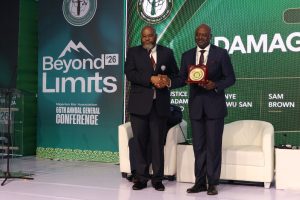
Experts Seek Consistency in Damages Awards at NBA AGC 2026
Panelists
- Hon. Justice Turaki Adamu Mohammed
- Emonye Adekwu, SAN
- Sam Brown
- Ama Etuwewe, SAN
- Miannaya Aja Essien, SAN, FCIArb
- Mr. Henry Chigbo
- Mr. Austine Omosigbo
- Dr. Moses Owede Vincent
Moderator
Mr. Peter Imoh Ekpaidot
Coordinator
Suleiman Abdulganiyu
Legal practitioners, valuation experts and industry stakeholders have called for greater consistency, credible evidence and clearly defined standards in the assessment and award of damages, particularly in oil-spill and environmental litigation.
The call was made during Breakout Session XI, titled “Damages & Discretion,” at the Nigerian Bar Association Annual General Conference in Port Harcourt.
The session examined whether Nigeria’s legal remedies are keeping pace with the changing oil and gas industry, particularly as disputes involving compensation, environmental responsibility, contractual accountability, regulatory enforcement and host-community rights become increasingly complex.
Giving an overview of the discussion, the moderator, Mr. Peter Imoh Ekpaidot, explained that the session was an interrogation of the gaps experienced in costly litigation before Nigerian courts.
He said the conversation was intended to identify measures that could promote greater consistency in damages awards while ensuring that judicial decisions remained firmly grounded in the evidence presented before the courts.
Lawyers Must Manage Clients’ Expectations
Speaking on the management of clients’ expectations, Ama Etuwewe, SAN, cautioned lawyers against giving clients absolute assurances about the outcome of litigation.
According to him, lawyers have a responsibility to prepare and present their clients’ cases professionally, but they must also be honest about the uncertainties associated with litigation.
He explained that where continued litigation might not produce the desired outcome, counsel should advise the client to consider negotiation or settlement.
Etuwewe noted that courts possess the discretion to award damages based on the evidence placed before them. However, where a decision is unfavourable or the discretion is not exercised in accordance with the law, the affected party may exercise the right of appeal.
“The exercise of discretion is not an avenue to award a windfall,” he said.
The panellists emphasised that judicial discretion must be exercised judicially and judiciously, with proper consideration of the law, evidence and peculiar circumstances of each case.
Courts Must Apply Damages Principles Fairly
Addressing the legal principles applicable to damages, Emonye Adekwu, SAN, explained that the assessment of compensation largely centres on general and special damages.
He noted that the purpose of compensatory damages is to restore an injured person, as far as money can reasonably achieve it, to the position the person would have occupied if the injury had not occurred.
Adekwu observed that judges are regularly confronted with the difficult task of determining the appropriate category and amount of damages to award.
He stated that although Nigerian courts continue to apply established legal principles, judges are sometimes restricted by existing statutory provisions.
He therefore advocated reforms that would enable judges to appoint independent experts to assist courts in highly technical disputes, particularly matters involving scientific, environmental and professional valuation evidence.
According to him, any major change in the principles governing damages must be supported by clear statutory provisions.
Oil-Spill Cases Present Evidential Challenges
Speaking on the difficulties associated with proving and defending damages in oil-spill litigation, Mr. Henry Chigbo identified recurring spills, prolonged disruption of fishing and farming activities, excessive claims and inconsistent evaluation reports as major concerns.
He explained that oil spills could prevent fishermen, farmers and other community members from carrying out their livelihoods for extended periods.
This, he said, often creates difficulties in determining the actual duration and financial value of the losses suffered.
Chigbo also identified situations in which claims were presented collectively on behalf of entire communities without a clear breakdown of the losses allegedly suffered by individual claimants.
The session further highlighted multiple ownership claims, the absence of survey plans and the difficulty of identifying the precise geographical area affected by an oil spill as common pitfalls in the assessment of damages.
Mr. Austine Omosigbo stressed the need for a comprehensive assessment whenever a spill occurs to identify the affected land, property, economic activities and persons entitled to compensation.
Valuers Must Follow Standard Procedures
The panellists emphasised the critical role played by estate surveyors and valuers in the determination of oil-spill compensation.
They called for the adoption of uniform valuation methodologies and templates to ensure that assessment reports were consistent, transparent and capable of withstanding judicial scrutiny.
The speakers said valuation reports should be supported by photographs, survey plans, accurate descriptions of the affected areas, population data and verifiable information about the economic activities of affected communities.
They also recommended the introduction of a definite timeframe within which assessments should be conducted.
According to them, prolonged delays could result in the alteration or disappearance of vital physical evidence required to establish the extent of the damage.
Damages Awards Affect the Economy
Addressing the wider economic implications of damages awards, Dr. Moses Owede Vincent stated that compensation ordered against a company did not affect only the immediate parties to the litigation.
He explained that excessive, speculative or poorly calculated awards could have consequences for businesses, investment and the wider economy.
Vincent urged judges to consider relevant factors such as depreciation, inflation and the changing value of money when determining compensation.
He, however, stressed that economic considerations should not be used to deny genuinely affected persons and communities adequate compensation for proven losses.
According to him, clear standards should be established for estate valuers and other professionals responsible for calculating environmental and economic losses.
He also urged judges to consider both legal principles and the environmental realities surrounding each case.
Judges Urged to Be Pragmatic
The panellists called on judges to strike a careful balance between protecting affected communities, enforcing corporate accountability and preventing speculative or arbitrary claims.
They cautioned against simply reproducing findings or damages awards from previous decisions without considering the peculiar facts and evidence presented in each case.
According to the speakers, judicial consistency does not mean awarding identical sums in every matter. Rather, it requires the consistent application of established legal principles to credible and properly evaluated evidence.
The session concluded with calls for legislative reform, uniform valuation standards, greater use of independent technical experts and a more pragmatic approach to the assessment and award of damages.
The panellists maintained that as Nigeria’s oil and gas industry continues to evolve, the country’s system of legal remedies must also develop to ensure an appropriate balance between commercial growth, environmental responsibility and justice for host communities.
Stella Charles Akupue
NBA Communication Officer
Photos: