From governance and insecurity to judicial independence, economic reform and political accountability, the session challenged lawyers to move beyond criticism and take their place at the centre of Nigeria’s reconstruction.
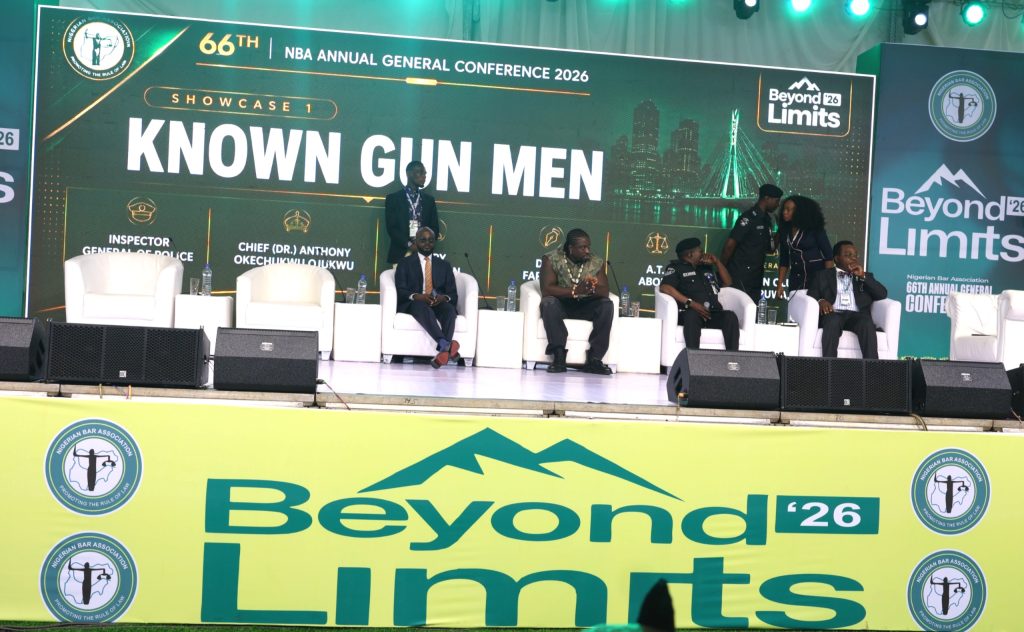
Nigeria’s future came under intense and uncompromising scrutiny as lawyers, policymakers, political leaders and changemakers gathered for the flagship session, “Nation Under Construction,” at the 2026 Annual General Conference of the Nigerian Bar Association.
Held on Day Four of the Conference, the session moved beyond familiar political slogans and ceremonial speeches to confront one defining question: Where does Nigeria go from here?
The distinguished panel featured human rights lawyer, Femi Falana, SAN; Senator Dino Melaye, Esq.; Professor Chidi Odinkalu; Hon. Muhammed Gudaji Kazaure; and Isaac Ssemakadde, President of the Uganda Law Society. The conversation was moderated and cordinated by Mohammed Adelodun.
From the opening exchanges, it became clear that the session would not offer comfortable answers. The speakers interrogated the condition of Nigeria’s democratic institutions, the independence of the judiciary, the responsibilities of the legal profession and the widening gap between constitutional promises and the daily realities of citizens.
The panel examined the country’s security challenges, economic hardship, electoral credibility, governance failures and the persistent erosion of public confidence in national institutions.
A central concern was the state of the judiciary and the responsibility of the legal profession to defend the rule of law. The discussion stressed that lawyers could not demand accountability from the political class while ignoring weaknesses within their own institutions. Participants were challenged to place national interest above personal, political and professional considerations.
The session also underscored the importance of a united and independent Bar. The panel warned that a divided legal profession would be unable to meet the expectations of the public or effectively resist threats to constitutional democracy. Lawyers across Africa, the session observed, must remain active participants in nation-building rather than passive witnesses to institutional decline.
Attention was equally drawn to Chapter Two of the 1999 Constitution and its provisions on education, welfare and social justice. The conversation questioned why constitutional commitments to the wellbeing of citizens remained largely unrealised, despite the oaths taken by elected public officers.
The panel called for stronger legal and institutional action to ensure that the promises of education, economic security and social development are translated into practical benefits for Nigerians. It also urged the Bar to confront electoral malpractice and demand higher standards from lawyers who assist political actors in undermining democratic processes.
On political leadership, the speakers maintained that Nigeria could not be rebuilt through rhetoric, religious sentiment or campaign promises alone. Citizens must choose leaders wisely, while those entrusted with public authority must be subjected to constant scrutiny.
The judiciary was similarly challenged to rise to its constitutional responsibility as the last hope of the common man and an essential safeguard against abuse of power.
The conversation broadened to include ethics, gender representation and youth participation. Lawyers were reminded that the public expects courage, integrity and moral leadership from the profession, particularly during periods of national uncertainty.
The panel advocated the creation of an enabling environment in which young Nigerians could participate meaningfully in governance, enterprise and national development. It further emphasised that genuine reconstruction would require boldness, inclusion and a willingness to reject systems that protect private interests at the expense of the country.
Women’s participation in political leadership and national decision-making also featured prominently. The session rejected the continued exclusion of women from positions of influence and called for deliberate action to dismantle structural barriers that limit their participation.
As questions came from the floor, the conversation became even more direct. Lawyers demanded practical solutions to judicial corruption, unlawful payments for bail, electoral manipulation and the failure of institutions to protect ordinary citizens.
The panel’s response was clear: lawyers must speak out, hold leaders accountable and restore the Nigerian Bar Association to its historic position as a fearless watchdog of government and public institutions.
Under Mohammed Adelodun’s firm moderation, the session refused to end with vague optimism. Instead, it concluded with a collective recognition that Nigeria’s reconstruction would require more than speeches, manifestoes or expressions of hope.
It would require leadership that accepts responsibility, institutions that command public confidence, citizens who demand accountability and a legal profession prepared to defend justice without fear or favour.
In a powerful final affirmation, participants acknowledged that Nigeria must do better and committed themselves to working towards a country governed by justice, inclusion, accountability and respect for the rule of law.
The message from the session was unmistakable: Nigeria’s next chapter will not be written by hope alone. It will be constructed through courageous leadership, strong institutions, an independent legal profession and sustained action by citizens who refuse to surrender the country’s future.