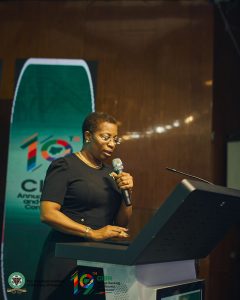
The Deputy Chief Registrar of the Community Court of Justice, ECOWAS, Mrs. Marie Saine, has called on journalists across West Africa to prioritise accuracy, context, professionalism and accessibility in reporting judicial proceedings and decisions of the regional court.
Mrs. Saine, who represented the Chief Registrar of the Community Court of Justice, ECOWAS, delivered the Welcome Address on his behalf at the opening of the maiden Training of the Network of Journalists from ECOWAS Member States Covering the Community Court of Justice in Abuja on Wednesday, September 16, 2026.
Welcoming participants, Saine described the training as more than the commencement of a professional development programme, saying it marked the beginning of a more structured and sustained engagement between the Court and journalists who play an important role in informing citizens across the Community about its proceedings, decisions and jurisprudence.
She explained that the ECOWAS Court occupies a distinctive place within the institutional architecture of the regional integration process and should not be viewed merely as a judicial institution where cases are filed, argued and determined.
Through its judgments, orders and jurisprudence, she said, the Court contributes to the development of principles of law, protection of human rights, access to justice and strengthening of the rule of law within the ECOWAS Community.
However, she stressed that the impact of a judicial institution cannot be measured solely by the number of cases it determines.
“A court must also be understood. Its mandate must be understood. Its procedures must be understood. Its decisions must be understood. And importantly, the significance of its jurisprudence for the people and the institutions of the region that it serves must also be understood,” she said.
According to her, “This is where the media becomes indispensable.”
Saine described journalists as an important bridge between the Court and the public, particularly because the overwhelming majority of citizens do not enter courtrooms regularly and may find judicial proceedings, legal arguments and court decisions technical, complex and remote.
She noted that through responsible journalism, a judgment delivered in a courtroom could reach citizens far beyond it, while accurate reporting could translate complex legal principles into language ordinary citizens can understand.
More importantly, she said, accurate and context-rich reporting should enable citizens to understand not only what the Court decided, but what the decision means and why it matters.
The Deputy Chief Registrar stressed that judicial reporting requires particular knowledge and professional judgment because a court reporter is not merely covering an event but a process governed by legal rules, procedures and principles.
She urged journalists to understand the distinction between allegations made by parties and established facts; submissions of parties and findings of the Court; procedural decisions and substantive determinations; and the legal significance of a decision as distinct from a reporter’s personal opinion on whether that decision is right or wrong.
“These distinctions are fundamental to credible judicial reporting,” she stated.
According to Saine, effective reporting therefore requires more than announcing the outcome of a case. It requires an understanding of the material facts, issues before the Court, relevant legal framework, reasoning of the Court and the orders ultimately made.
She stressed that accuracy must remain the foundation of judicial reporting, warning that inaccurate reports could misrepresent a litigant’s position, distort the substance of a judgment or create misunderstanding of the law.
At the same time, she said accuracy should not come at the expense of accessibility, particularly within ECOWAS’ multicultural, multilingual and culturally diverse community.
“The objective is not to turn every court report into a legal treatise, but to ensure that the public receives information that is accurate, clear, balanced and sufficiently contextualised,” she said.
Saine also emphasised the importance of reporting independently while respecting judicial independence.
She explained that the relationship between the Court and the media must be based on mutual respect for their respective institutional roles: the Court has the responsibility of administering justice, while journalists have the responsibility of independently and professionally informing the public.
According to her, the Court does not seek to determine journalists’ editorial decisions but seeks to ensure that journalists have appropriate access to reliable information necessary to report its work accurately and independently.
She highlighted the important roles of the Registry and the Public Information and External Relations Unit in facilitating access to judicial information, while acknowledging the need to continually improve the mechanisms through which information is provided without compromising confidentiality, privacy and applicable rules of the Court.
Turning to the newly established network, Saine expressed hope that it would develop into a professional community of journalists across ECOWAS Member States with a shared understanding of the Court and its regional significance.
Beyond the training, she said the network could facilitate the exchange of experiences, promote wider coverage of the Court’s proceedings and jurisprudence, and provide journalists with a platform for identifying common challenges and sharing practical approaches to reporting regional justice.
She also described the network as an important channel for dialogue between the Court and the media, noting that journalists’ experiences and feedback could help the Court better understand their information needs and strengthen its communication with the public.
During the training, participants are expected to deepen their understanding of the Court’s mandate, jurisdiction, procedures, jurisprudence and institutional structure while developing practical skills for reporting judicial proceedings and decisions.
Saine encouraged participants to ask questions, share experiences and openly discuss the challenges encountered while covering the Court.
“This should be a dialogue rather than a one-way transfer of information. The Court has knowledge and experience to share, but journalists also bring valuable practical perspectives that can help us improve,” she said.
She said the success of the initiative should ultimately be reflected in better reporting and greater public awareness of the Court — its existence, mandate, decisions, jurisprudence and contribution to justice, human rights and regional integration.
Against the backdrop of the speed at which information and misinformation now travel, she stressed that the appropriate response must be communication that is timely, accurate, transparent and properly contextualised.
“The Court’s work should not remain confined to judgments and courtrooms. It should be understood not only by legal practitioners and institutions, but by the citizens whom the Community serves, and responsible journalism is one of the most important means through which that understanding can be achieved,” she stated.
Concluding, Saine called on participants to use the initiative to build a lasting partnership with the Court founded on accuracy, professionalism, independence, accessibility, mutual respect and public interest.
She welcomed the participants on behalf of the Chief Registrar and wished them a productive, engaging and successful training.
Source: Community Court of Justice, ECOWAS. Welcome Address delivered by Mrs. Marie Saine, Deputy Chief Registrar, representing the Chief Registrar, at the opening of the Training.