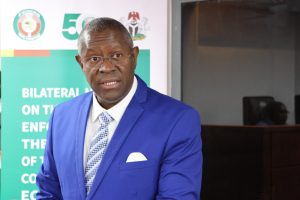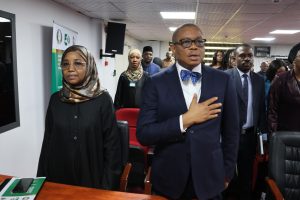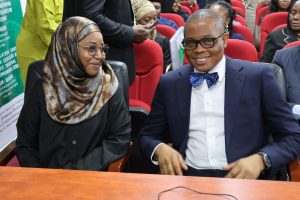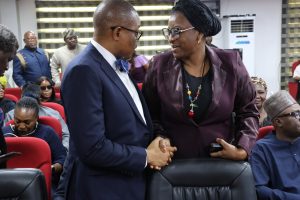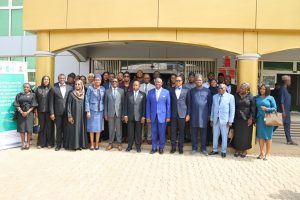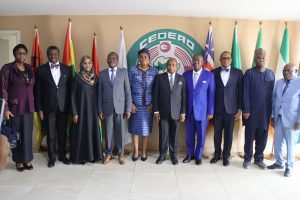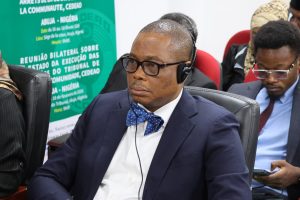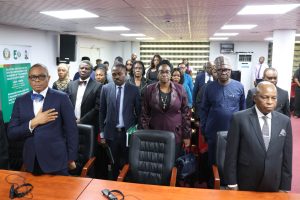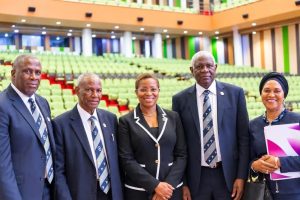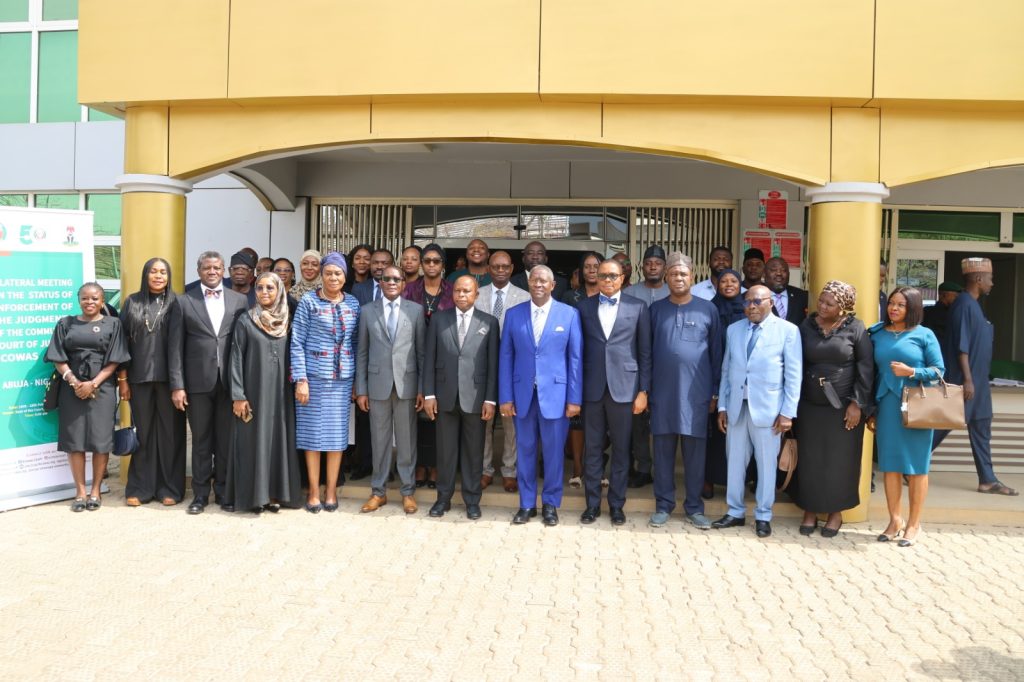
At the bilateral meeting between the ECOWAS Court of Justice and the Federal Republic of Nigeria, held as part of activities marking the 50th Anniversary of the Court, the President of the Court, Hon. Justice Ricardo Cláudio Monteiro Gonçalves, delivered a formal address emphasizing the legal obligation of Member States to execute the Court’s decisions and the broader implications for regional integration and the rule of law.
Addressing the Honourable Minister of Justice and Attorney General of the Federal Republic of Nigeria, the Vice-President and Judges of the ECOWAS Court, the President of the Nigerian Bar Association, distinguished representatives of Nigeria, members of the delegation, and invited guests, President Gonçalves expressed appreciation for Nigeria’s availability for the bilateral engagement.
The meeting was described as a clear sign of institutional maturity and commitment to the founding ideals of the Economic Community of West African States (ECOWAS), particularly at a historic milestone in the life of the Court.
The central focus of the meeting was the execution of the Court’s judgments. President Gonçalves underscored that the obligation to execute decisions of the Court is clearly grounded in Community legal instruments, including the Revised ECOWAS Treaty (1993); Protocol A/P.1/7/91 relating to the Community Court of Justice as amended by Supplementary Protocol A/SP.1/01/05; Supplementary Act A/SP.13/02/12 on sanctions against Member States that fail to fulfil their obligations to ECOWAS; and Supplementary Act A/SA.1/12/25 relating to the Community Court of Justice.
These instruments establish that:
- Judgments of the Court of Justice are binding on Member States, Community institutions, and natural and legal persons;
- Decisions of the Court are final and have immediate enforceable effects.
- States must designate a competent national authority responsible for execution.
It was emphasized that execution of the Court’s decisions is not a political option but a legal obligation arising from binding Treaty and Protocol commitments.
The Court was described not merely as a judicial body but as a pillar of regional rule of law, giving practical expression to commitments undertaken by Member States.
The President acknowledged that non-execution of judicial decisions does not, in most cases, stem from formal refusal but from structural, institutional, and operational factors. Among the principal challenges identified were:
1. Internal institutional challenges, including the absence of specific national coordination mechanisms for implementing Court decisions;
2. Administrative and budgetary complexities, particularly where decisions involve financial compensation or structural reforms;
3. Inadequate internalization of Court decisions into domestic legal systems, whether due to technical unfamiliarity or insufficient normative harmonization;
4. Difficulties in coordination among the Executive, Legislative, and Judicial branches in fulfilling Community obligations;
5. Political sensitivity of certain matters, especially those involving human rights or high-impact administrative measures;
6. Limited enforcement mechanisms and insufficient involvement of ECOWAS political organs, with sanctions regimes not effectively utilized;
7. Absence of a direct enforcement mandate, as the Court is not legally empowered to supervise or directly execute its decisions and therefore relies on Member States’ goodwill;
8. Lack of prompt responses or updates from Member States on the status of execution;
9. Diversity of legal systems, including differences in civil law procedures among Member States.
These factors were presented not as accusations but as institutional realities requiring structured responses and enhanced cooperation.
President Gonçalves outlined the serious consequences of non-execution, including erosion of the Court’s authority and weakening of the Community legal order; loss of citizens’ confidence in regional justice; negative impact on the international image of the Community and its Member States; the creation of a dangerous precedent of relativizing Community obligations; and weakening of the regional integration process, which depends on mutual trust and respect for commitments.
He stressed that without execution, decisions of the Court become merely declaratory, and declaratory justice without practical effect cannot fulfil its transformative role, an issue of particular significance as the Court marks five decades of its institutional journey.
Turning specifically to Nigeria, President Gonçalves recognized the country not only as a Member State but as a founding nation of ECOWAS, a regional economic engine, and a political and diplomatic leader.
Since the establishment of the Court, 128 cases have been instituted against the Federal Republic of Nigeria. Of these, 66 have been closed, 10 have been executed, and 52 remain pending execution.
These figures were presented not as censure but as an objective basis for reflection. It was noted that Nigeria possesses the institutional capacity, democratic maturity, and regional influence to assume an exemplary role in executing the Court’s decisions.
Leadership by example, he stated, would reinforce the authority of the Court, send a clear message of commitment to regional rule of law, encourage other States to follow suit, and consolidate Nigeria’s normative leadership in West Africa.
The meeting was described as an opportunity not only for diagnosis but for solutions. The Court highlighted several initiatives already adopted, including:
- Creation of a specific execution division within the Registry, headed by a Registrar;
- Regular dialogue with designated National Competent Authorities;
- Establishment of execution deadlines within judgments, requiring parties to inform the Court of compliance within specified timeframes;
- Sharing information on execution during annual international conferences and sensitization visits;
- Correspondence urging Member States to ratify all Community texts relating to the Court;
- Follow-up with States that have not designated a National Competent Authority;
- Requests for information from Member States, Community Institutions, and other entities on the status of execution;
Presentation of the status of execution during meetings of the Council of Ministers and the Authority of Heads of State and Government.
While acknowledging that these measures may not be sufficient and could be improved, President Gonçalves emphasized that the objective of the meeting, particularly in this 50th anniversary year, was not to constrain but to build sustainable solutions and jointly chart the way forward.
In conclusion, he reaffirmed that ECOWAS was created to promote integration, stability, prosperity, and justice, and that the Court remains a central instrument of that vision. Execution of its decisions was described not as a favour to the Court but as a commitment to the citizens of the region and to the Community project itself.
President Gonçalves expressed confidence that through frank and constructive dialogue, the challenge could be transformed into a historic opportunity for institutional strengthening, marking the beginning of a new phase of enhanced cooperation between the ECOWAS Court and the Federal Republic of Nigeria as the Court enters its next fifty years.
Photos: